

Home Sales Pick Up in June, but Market Still Sluggish
Activity in Canada’s housing market saw some early signs of renewed life in June, following the Bank of Canada‘s interest rate cut at the beginning of the month.
“It wasn’t a ‘blow the doors off’ month by any means, but Canada’s housing numbers did perk up a bit on a month-over-month basis,” says Canadian Real Estate Association (CREA) senior economist, Shaun Cathcart. “Year-over-year comparisons don’t look great mainly because of how many buyers were still jumping into the market last spring, but that’s a story about last year. What’s happening right now is that sales were up from May to June, market conditions tightened for the first time this year and prices nationally ticked higher for the first time in 11 months.”
Home sales activity recorded over Canadian MLS systems climbed 3.7 per cent between May and June.
As of the end of June, there were approximately 180,000 properties listed for sale across the country, an increase of 26 per cent from a year earlier but still below historical averages of around 200,000 for this time of the year. On a seasonally adjusted basis, the end-of-June supply number was only up 0.5 per cent from the end of May, suggesting the national inventory buildup may be slowing down.
New listings posted a 1.5 per cent month-over-month increase in June, led by the Greater Toronto Area and British Columbia’s Lower Mainland.
As the national increase in new listings was smaller than the sales gain, the national sales-to-new listings ratio tightened to 53.9 per cent compared to 52.8 per cent in May. The long-term average for this ratio is 55 per cent, with a sales-to-new listings ratio between 45 per cent and 65 per cent generally consistent with balanced housing market conditions.
“The second half of 2024 is widely expected to see the beginnings of a slow and gradual return of buyers into the housing market,” says CREA chair James Mabey. “Those buyers will face a considerably different shopping experience depending on where they are in Canada, from multiple offers in places like Calgary, to the most inventory to choose from in over a decade in places like Toronto.”
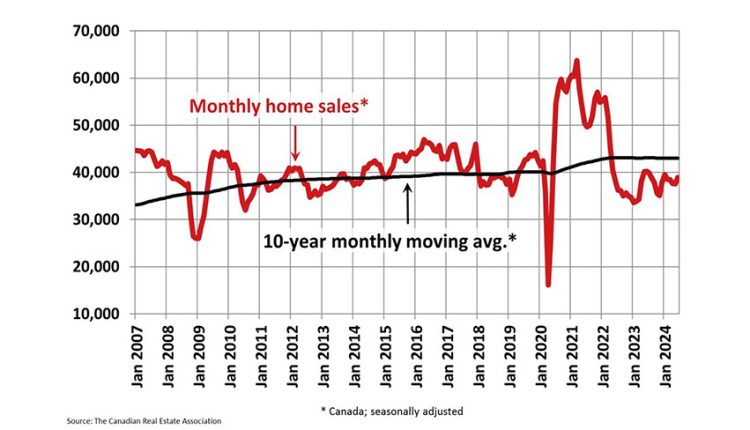
There were 4.2 months of inventory on a national basis at the end of June, down from 4.3 months at the end of May. It was the first time this number has fallen month-over-month in 2024.
Months of inventory indicates how long it would take to completely sell the homes that are currently listed for sale, based on the current rate of sales activity.
The national composite MLS home price index (HPI) inched up 0.1 per cent from May to June. While a small increase, it was noteworthy in that it was the first month-over-month gain in 11 months.
Regionally, prices are still generally sliding sideways across much of the country. The exceptions remain Calgary, Edmonton and Saskatoon, and to a lesser extent Montreal and Quebec City, where prices have steadily moved higher since the beginning of 2023.
That said, there have been some more recent upward movements in prices in other markets, primarily in Ontario, including across cottage country, Mississauga, Hamilton-Burlington, Kitchener-Waterloo, Cambridge and London-St. Thomas. Halifax-Dartmouth in Nova Scotia has also seen prices rise, albeit modestly.
The non-seasonally adjusted national composite MLS HPI stood 3.4 per cent below June 2023. This mostly reflects how prices took off last April-July, something that has not been repeated in 2024.
The actual (not seasonally adjusted) national average home price was $696,179 in June, down 1.6 per cent year-over-year.