
Students Design Appliances for Differently-abled Persons
Students in Sweden have developed home appliances to assist people with disabilities as part of a challenge proposed by Electrolux Group.
Four teams at Umeå Institute of Design (UID) created unique product concepts under the theme, design for all abilities, in just three weeks.
“These talented students really stepped into the consumer’s shoes,” says Timo Mashiyi-Veikkola, head of design research at Electrolux. “They came up with creative solutions that not only make it easier for people with a range of disabilities to use, but also considered safety and aesthetics. These fresh ideas are inspiring and suit our human touch design philosophy. One important element of that is design with empathy and quality.”
The home appliance designs include Elva, Alva, Ease and Autocare, all of which make use easier by people with disabilities, from deteriorating eyesight to arthritis.
Elva is a semi-built-in hot beverage maker designed to reduce the risk of burns and to require very little arm strength. Lowering the pouring module minimizes the risk of hot water spilling and the user selects the desired water temperature with a simple slider. Signals are acoustic and visual, not textual.
Alva is a dehumidifier whose top-positioned water tank enables effortless refilling and an ergonomic handle ensures a secure grip. The tank pops up when full and has a flat side so that it can be set down for emptying. The control interface is simplified; it can be operated by voice commands. And the companion app enables remote operation. It doubles as a drying rack.
With a top-loading mechanism, the Ease oven eliminates the physical strain of bending and lifting required by traditional ovens. Users slide dishes onto a tray at countertop level and the oven lowers it into the heat cavity. It features single-button control, high-contrast lighting and clear visual indicators to enable an easier, safer cooking experience.
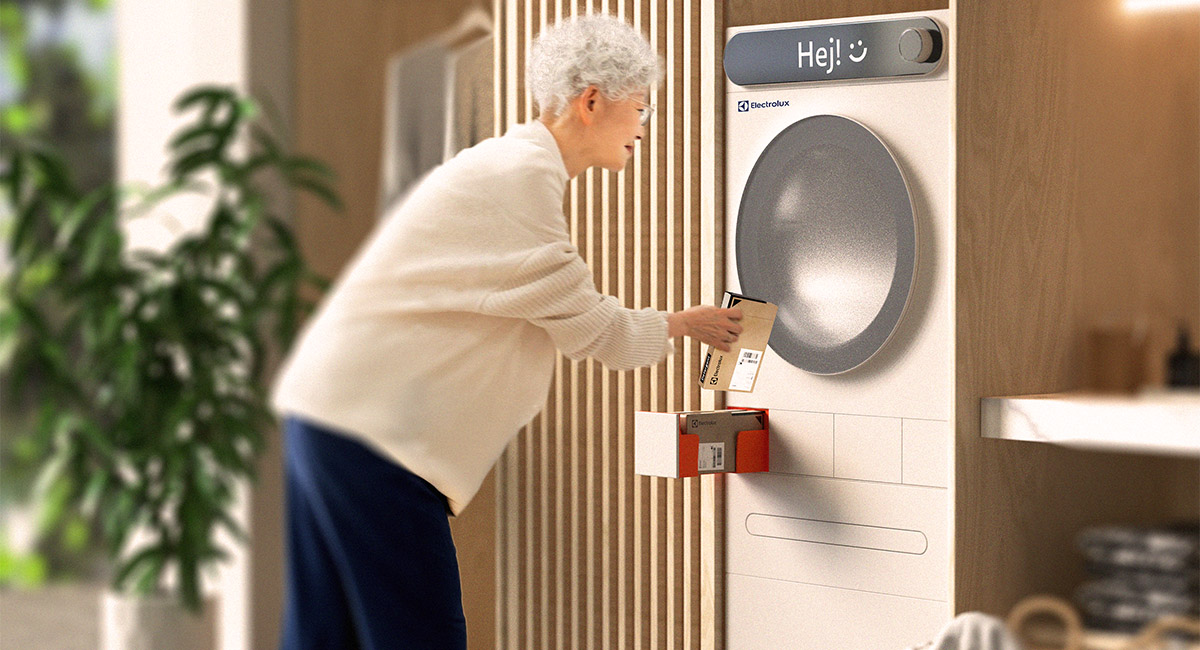
Autocare reduces the effort required to do laundry with a large, tactile knob, a font designed for the visually impaired, and an intelligent interface that remembers favourite cycles and responds to voice activation. It features an auto-dosing system using detergent sheets rather than heavy liquid, and a lint compressor for less frequent emptying.
This is the seventh year Electrolux has collaborated with UID on the design challenge. Previous themes have included designs for an artificial intelligence-assisted home robot as the primary user, single people living in small spaces and multi-generational homes.
“It’s always rewarding to work with Electrolux on these design sprints,” says Thomas Degn, associate professor and director of the master’s program in advanced product design at UID. “It’s a real-world test of our students’ skills and helps us all imagine a better world through design.”