
Tips for Remerchandising After Market Purchases
By Lori Friedlander
It’s easy to get caught up in the excitement of a major furniture market like those held in Las Vegas and High Point, N.C. Inspirational, fresh new product launches, endless lineup of parties, connecting with new and existing vendor partners and colleagues. It can feel like a whirlwind. Yet, at each market, buyers are tasked with sorting through it all and selecting the most popular products at the best value to display and offer to customers. While many buyers come to market with a shopping list in hand, they start purchasing emotionally, deciding to take advantage of a hot market special or swayed by either a skilled sales representative or one with whom they’ve formed a long-term relationship and feel compelled to make loyalty purchases. Trying to replace product based solely on an existing floor plan and historical sales doesn’t net the best results, either. Instead, having the right merchandising mix, store layout and branding in place are the keys to getting a market buying event right.
Finding the Right Balance
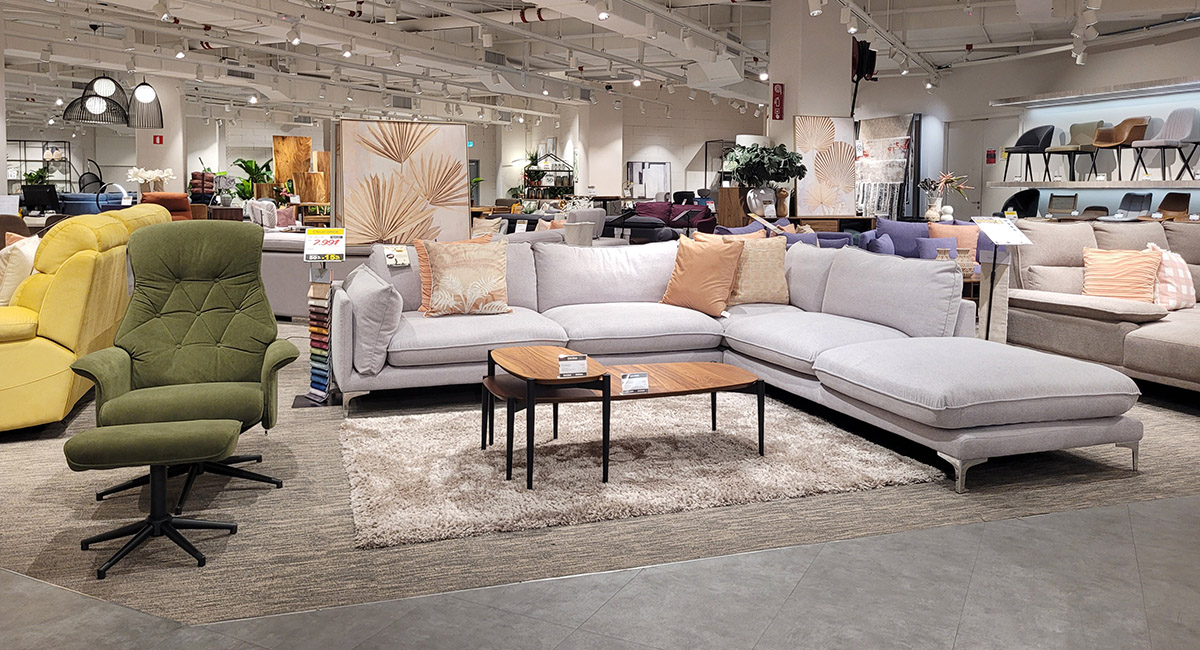
It is said that visual merchandising sells product without saying a word. That’s why it’s critical to make sure every vignette performs at or above your sales per square foot goal.
A review of your existing merchandising mix and how closely it reflects sales provides a roadmap of the voids in the mix and opportunities for making well-thought-out, strategic purchases. Your merchandise mix should include product categories, styles and price points in every vignette that directly correlate and reflect in-store sales. (Face time with customers and sales staff can further help identify the most important styles and price points per category.) It also makes sense to compare your metrics to industry standards as a guideline to see where you might be underperforming. So, for example, if upholstery sales represent 60 per cent of in-store sales, then 60 per cent of your slots should be upholstery. Same goes for modern styling. If it represents 40 per cent of upholstery sales, then 40 per cent of those slots should be modern. In other words, the correct number of slots and square footage per category as it relates to sales should be reflected in your store’s layout.
In addition to sales reporting, a floor plan to scale accurately representing slot count and product layout is a vital tool to accurately measure these metrics. Let’s look at an example. It’s common practice to replace an underperforming dining group with another dining group. But if analysis shows the number of slots dedicated to dining greatly exceeds the slots as a percentage of sales, it should perhaps be replaced with a bedroom or upholstery grouping where scrutiny might show you are underrepresented.
Before making the decision to remove a poor performer from the sales floor, it is necessary to consider factors like a bad location, whether it was recently moved or recovered/refinished or it did, in fact, just become outdated. Many times, a simple floor move can make a great impact. Also, when considering why a particular vignette isn’t performing, ask yourself if staff product training may be inadequate, particularly for new product launches. Nothing hinders the sales of any product more than when sales staff aren’t confident selling it.
The Power of Sight
Visual merchandising is more than just the planning and displaying of product. Once your merchandising mix has been planned and product selections have been made, it is important that each vignette and the store as a whole convey your brand’s messaging.
Beyond a tidy exterior, upon entering the store, your customer should be greeted with an entrance that is open and uncluttered. Check that lighting is adequate and properly pointed, with no burnt-out light bulbs. Ensure music and temperature are at appropriate levels, and all store fixtures and surfaces are clean and well-maintained. All product furnishings and accessories within vignette settings need to be dust-free, lamp shades and artwork straight, rugs taped down with no frayed edges, and upholstery seat and back cushions, as well as toss pillows, plumped. For ease of shopping, aisleways should be at least three-feet wide with no blocking or tripping hazards and free of debris. Additionally, all vignette furniture and furnishings must be clearly marked with accurate pricing.
Your store should reflect pride with point-of-purchase materials that are current and in good condition, and displays that are in ‘like new’ condition with no product holes on the floor. Any sold items are to be removed from display and replenished in a timely fashion. Wall colours should be up-to-date and harmonious with branding, paint scuff-free, and nail holes in walls patched and re-painted. Timely seasonal displays can be incorporated to invite customers to explore and anticipate returning more often.
Building a Strong Identity
Pulling it all together, don’t forget your brand is a story unfolding across all customer touchpoints. A well-merchandised store is fully rounded out by the message it tells the consumer. Be sure visual messaging connects with your target audience and the main drivers of your business are well-represented. If known for fast delivery of in-stock products, then your stock versus special order slots percentages on the floor should reflect those sales. Don’t forget about the music and scent of the store and how it aligns with your visual messaging. Your store needs to be enjoyable for customers to navigate so they are not confused and can easily find what they want. Ideally, products are displayed and categorized by lifestyle, product category or both.
Getting the most out of your product buys becomes easier when following the strategies laid out. Solidifying your merchandising mix, store layout and branding create the foundation on which well-planned purchasing decisions are made. Scrambling to figure out what to do first when you return from market then becomes a struggle of the past.
Lori Friedlander is principal of Furnia Home, a furniture and home furnishings consulting firm. With more than 20 years of experience, Lori has worked with both family-owned and corporate entities, including renowned brands Ethan Allen, La-Z-Boy and Bassett Furniture. Lori can be reached at lori@furniahome.com.