

Patrick Risdon Turns Hobby into Furniture Business
By Tyler Holt
Patrick Risdon’s journey into wood furniture-making is a testament to his passion, resilience and the pursuit of meaningful craftsmanship. With a background in IT professional services, he spent years working in a fast-paced industry, but his true interests lay elsewhere.
“I wasn’t excited about the job I was doing,” says Risdon. “I loved the people I worked with, they were really good to me, but there was just something missing.”
Before making the career leap, Risdon spent his free time watching timber framing videos, experimenting with small projects and working with limited tools in his garage. However, balancing work, family life and a growing hobby wasn’t easy.
When the Covid-19 pandemic hit, Risdon saw an opportunity to pursue his passion full-time. He relocated with his family to Arnprior, Ont., a region known for its towering trees and deep forestry history. The move gave him not only a change of pace but also a 24-foot by 30-foot workshop — the perfect space to transform his woodworking hobby into a bona fide career.
What began with cutting boards and small projects soon turned into a serious furniture-making business, Risdon Furniture, that creates pieces with a story, connection and lasting impact.
Sustainability and Storytelling
For Risdon, woodworking is about more than just creating furniture — it’s about honouring the material and its origins. From the very start, he committed to sourcing wood responsibly, choosing to work with fallen trees, storm-damaged lumber, and slabs from small sawmills and farmers instead of relying on mass-produced materials.
He recalls a defining moment early in his journey when he was offered a batch of maple slabs from a sugar bush. Initially, he purchased only half; however, after recognizing their significance, he quickly returned to buy the rest.
“I said, you know what? Every piece of wood has a story and people want to connect to that,” recalls Risdon, who has developed a deeper appreciation for the history of the wood he works with.
This realization led Risdon to find ways to make that connection tangible. He began engraving GPS coordinates onto his work, marking the exact location where the tree had once stood. Customers responded strongly, appreciating not just the craftsmanship but the connection to the material itself.
This approach set his work apart, turning furniture into conversation pieces with meaning. His customers weren’t just purchasing tables and countertops — they were investing in a piece of history tied to a specific place and moment in time.
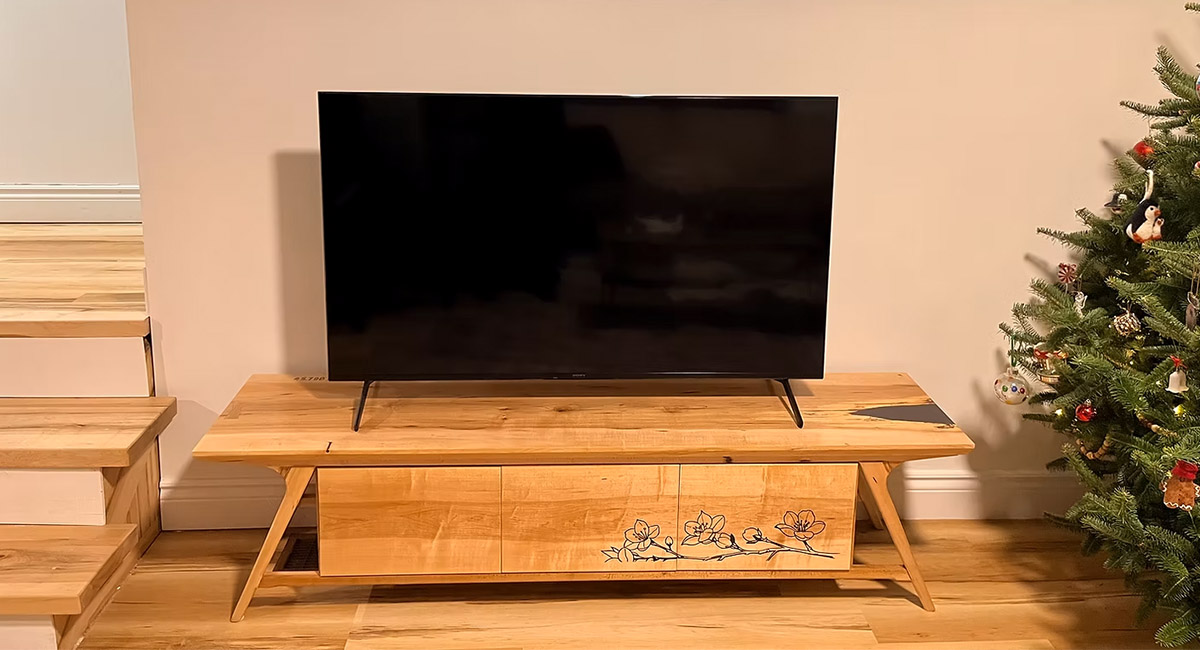
Communicating Craftsmanship and Connection
Like many artisans, Risdon understood early on that people don’t just buy handcrafted furniture — they invest in the meaning behind it. While his work spoke for itself in quality and craftsmanship, he knew helping customers truly appreciate what’s involved in making each piece required more than just putting it up for sale.
“The more people understand the process, the more they appreciate the final piece,” he explains.
This led him to focus on transparency and storytelling, giving people a deeper look into the materials, techniques and artistic decisions that go into every project. He began documenting his work through videos and social media, allowing potential buyers to see how a raw slab of wood transforms into a meticulously crafted table or bench.
“If someone watches me build a table from start to finish, they understand the time, skill and passion that goes into it,” he says. “They’re not just seeing a price tag, they’re seeing a journey.”
The impact was immediate. His very first YouTube video gained 5,000 views in just two weeks, and his subscriber count grew rapidly. More than just increasing visibility, it created a deeper emotional connection between his work and his customers.
“I had people reaching out, not just asking about pricing but asking about the wood, the process, the meaning behind the pieces,” says Risdon.
This approach has not only helped customers appreciate the value of handcrafted work but has also reinforced the idea that woodworking is an art form, not just a trade.
Looking ahead, Risdon hopes to continue expanding his reach, taking on larger commercial projects while maintaining the authenticity and quality that define his work. Whether crafting a boardroom table with a deep history or a family dining table meant to be passed down through generations, he remains committed to making furniture that tells a story and stands the test of time.
“I want my work to outlive me,” he says. “I want people to look at a table I made 50 years from now and still feel a connection to the wood, the craftsmanship and the story behind it.”
Tyler Holt is the editor of Wood Industry magazine, a Mediaedge-produced publication. He has a master’s degree in literation and publication, and years of experience in the publishing and digital media industry.